Authenticated connections.
PKI-backed identities and encrypted transport connect local applications, onboard servers and shoreside services. Segmentation and controlled gateways separate legacy networks.
MARINE EDGE & SYSTEMS INTELLIGENCE
Marine SCADA and edge-to-cloud intelligence. A connected view of machinery, operations and the people responsible for them—for private yachts, charter operators and superyacht teams.
Discover the platformONBOARD INTELLIGENCE · ENTERPRISE ARCHITECTURE
01 / THE PLATFORM
The value is not another stream of data. It is understanding what changed, why it matters and who needs to know.
Yachtrix connects onboard acquisition, local processing and authorized shoreside access. Equipment signals, alarms and operational history come together in a common engineering context.
Hardware, interfaces and service scope are specified for each installation.
PLATFORM / THE CONNECTED PICTURE
Security across the whole data path: local acquisition, onboard processing and authorized shoreside access. Trust boundaries matter as much as connectivity.
01 / ONE YACHT
Acquire · buffer · process
Local data protected at rest
02 / CLOUD OR PRIVATE CLOUD
Telemetry · events · history
Encrypted storage · backups
03 / INTELLIGENCE & PEOPLE
Trips & sailing · machinery & energy
Alarms & maintenance context
AI anomalies & prediction Research roadmap
Crew & engineers
Charter & fleet operators
Authorized service & OEM teams
PKI-backed identities and encrypted transport connect local applications, onboard servers and shoreside services. Segmentation and controlled gateways separate legacy networks.
At-rest protection covers local buffers, databases, cloud storage and backups. Storage-key custody, access policies and recovery remain distinct from device identity.
PKI-based device and service identity, with mutual TLS on supported connections. Enrolment, renewal, revocation and private-key protection account for intermittent connectivity.
Transport encryption protects connections; at-rest encryption protects stored data. End-to-end encryption restricts decryption to designated endpoints. These are distinct protections.
A cloud analytics service processing readable telemetry is an authorized endpoint—not a blind intermediary. Cloud-blind processing keeps decryption and analysis on board or at an authorized private endpoint.
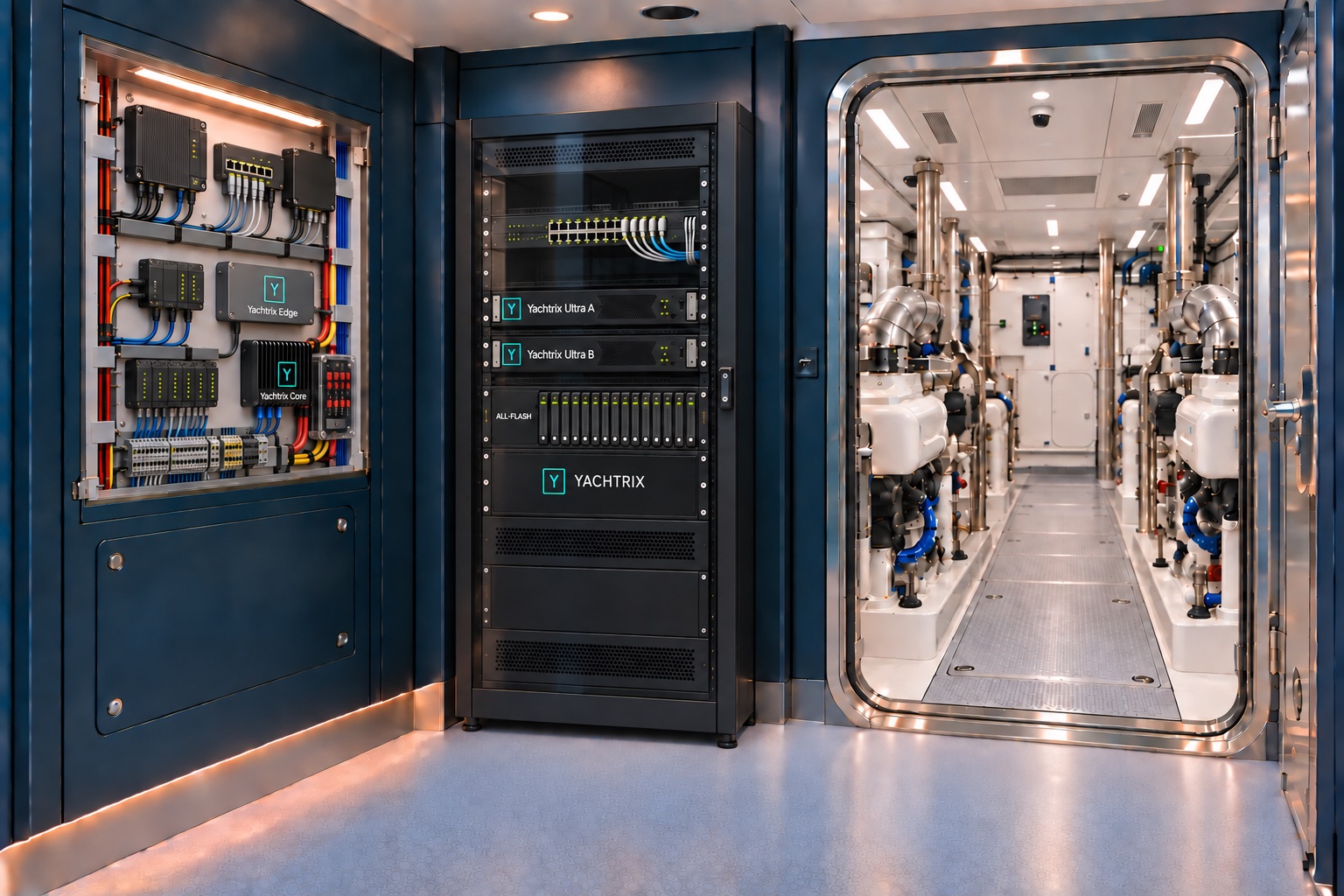
Onboard imagery is AI-generated concept art, not an installation drawing or manufacturer endorsement. Equipment selection and integration follow the installation specification.
02 / CONNECTIVITY
Marine networks, industrial interfaces, wired and wireless sensors, and remote services—connected through an equipment-specific integration layer.
Interface selection follows the yacht’s equipment, network boundaries and access permissions.
The integration architecture covers NMEA 2000, J1939, NMEA 0183, Modbus, CAN-based systems, PROFIBUS, serial links, digital I/O and equipment APIs. Device-specific signal definitions preserve source, units, timestamps and quality.
Ethernet, wireless and low-power mesh networks extend acquisition throughout the yacht. Gateways connect distributed sensors to the data layer, with machinery, management, crew and guest traffic kept in separate network zones.
PKI-backed identity, encrypted transport and controlled access span supported local, onboard and yacht-to-shore connections. Marina, cellular and satellite networks provide the uplink—not the trust boundary.
Legacy marine buses remain behind restricted gateways. Encryption begins at the capable gateway or endpoint; native fieldbus traffic is not inherently encrypted. Local history, cloud data and backups have separate at-rest protection.
Start with essential signals, then extend equipment coverage, local processing and fleet visibility. Documented interfaces preserve a consistent data model as the installation grows.
The API layer connects onboard context with weather, marine forecasts, charter bookings, maintenance records, work orders and marina services. Passage reviews gain environmental context; charter schedules define service windows.
Each service integration has a defined data contract, authorized access, licensing terms and update policy.
Acquisition spans propulsion and electrical loads, freshwater and bilge pumps, tank levels, door and hatch contacts, and presence events. Camera interfaces belong in the same integration layer, with privacy and access policies set by the operator.
Monitoring access grants no actuation authority. Navigation, protection, interlocks and emergency functions remain independent of Yachtrix and shoreside connectivity.
ON BOARD / THE CONNECTED ENVIRONMENT
A yacht is an ecosystem of specialist equipment. Yachtrix brings its operational context together—alongside the systems crews already know.
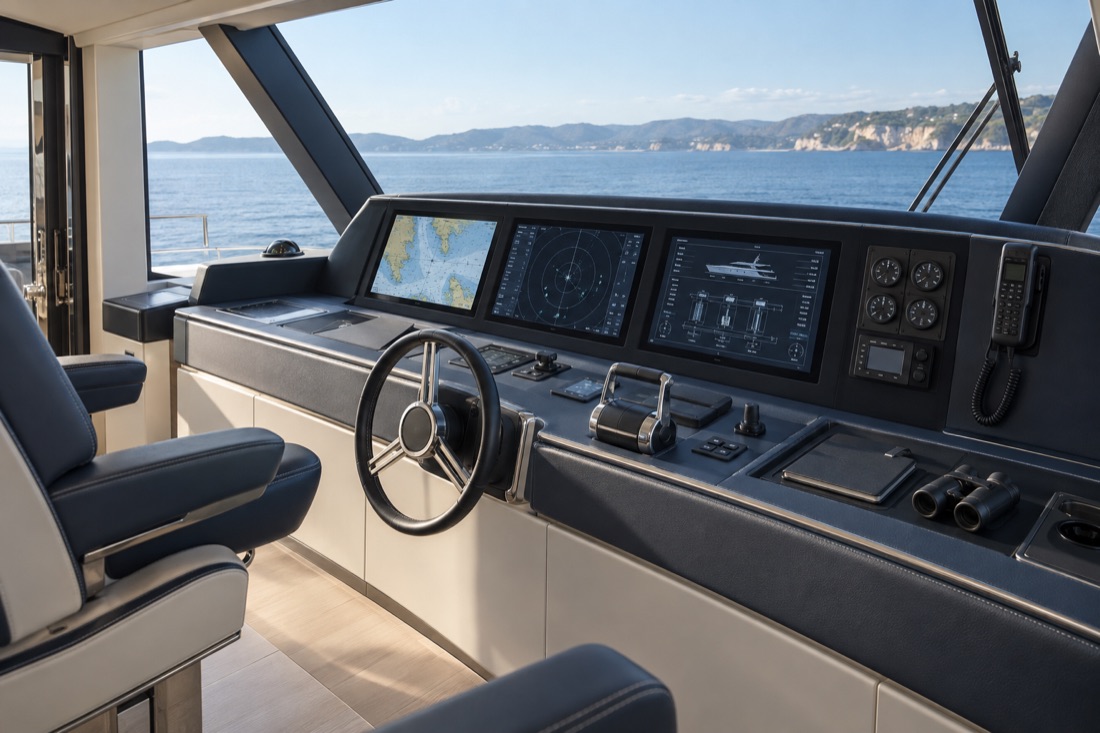
Position, speed, wind and depth give machinery and energy data their operating context. Passage reviews connect what happened at sea with what happened below deck.
NAVIGATION CONTEXT · TRIP HISTORY · OPERATOR AWARENESS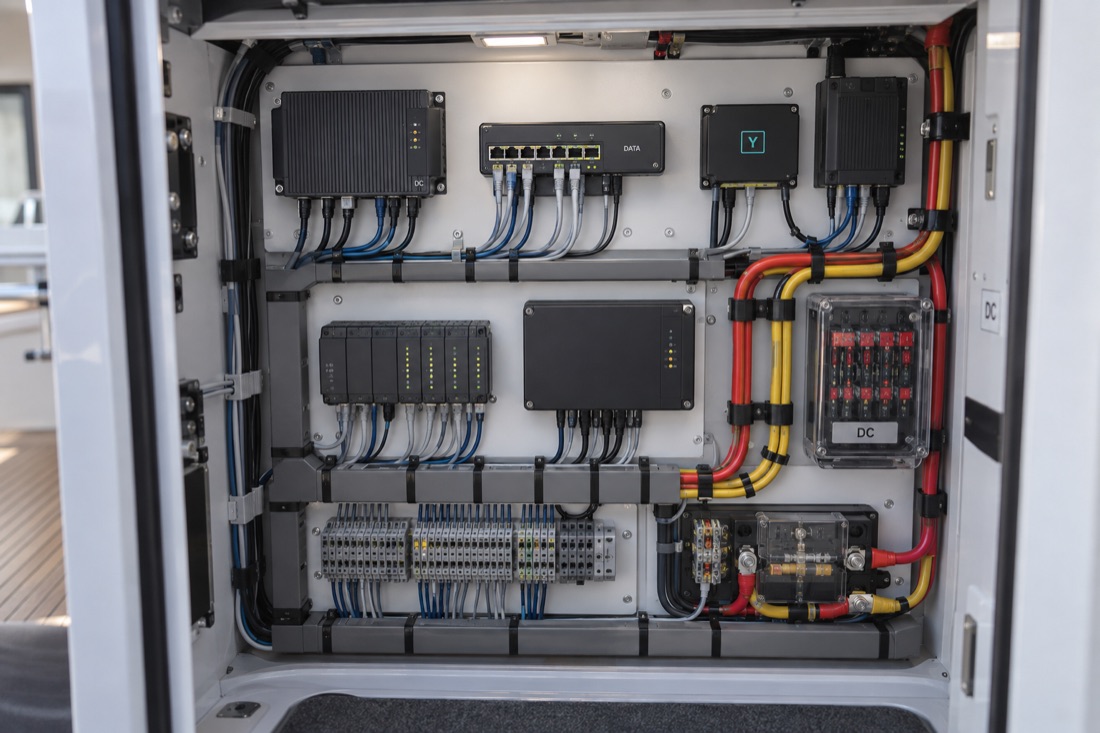
Marine black boxes, network switches, distributed I/O and power systems form the onboard environment. Controlled interfaces bring selected signals into a consistent, time-stamped record.
MARINE NETWORKS · DISTRIBUTED SYSTEMS · EDGE ACQUISITIONTHE EQUIPMENT ECOSYSTEM
Functional relationships—not a wiring diagramMFDs · position · AIS
Wind · depth · radar context
Communications · gateways
NMEA 2000 · Ethernet · OEM interfaces
Engines · power · pumps · tanks
Contacts · sensors · camera events
Source-aware telemetry, alarms and history for crew, engineers and authorized shore teams.
Equipment-specific access defines the integration. Native navigation, radio, autopilot and safety systems remain authoritative; monitoring grants no control authority. Concept imagery is not an installation drawing.
03 / OPERATIONAL INTELLIGENCE
Beyond individual systems: the relationships between movement, machinery and the decisions that keep an operation running.
Passage history brings operating conditions, weather and energy demand into focus. Review sailing performance, time under power and changes between trips using the yacht’s available signals.
PASSAGES · CONDITIONS · PERFORMANCEMachinery trends, power demand and event history explain changing behaviour in context. Compare conditions across operating modes—not just isolated readings.
MACHINERY · ENERGY · DIAGNOSTICSRelevant information reaches crews, charter operators and authorized shoreside teams. Issue response, service windows and maintenance planning share one operational record.
READINESS · MAINTENANCE · FLEETIllustrative graphics. Analysis follows the available signals and installation scope; predictive diagnostics remain on the AI roadmap.
APPLICATIONS / DIFFERENT YACHTS. SHARED INTELLIGENCE.
Private ownership, professional charter and worldwide cruising. Each operating profile brings different questions to the same connected architecture.

PRIVATE · PASSAGE-MAKING
Connect sailing performance with wind, sea conditions and energy demand. Review time under sail and power, battery trends and machinery hours across an extended itinerary.

PRIVATE & CHARTER · ENGINEERING OPERATIONS
Place propulsion, generators and hotel loads in the same operating context. Compare trends by running mode and give engineering teams the history behind an alarm.

CHARTER · TURNAROUNDS & GUEST READINESS
Bring twin auxiliary engines, batteries, tanks and service issues into the turnaround record. Link trip history with booking schedules to make the interval between charters count.
Image source: Windward Yachts

PRIVATE & CHARTER · MULTI-BASE OPERATIONS
Compare port and starboard propulsion in context, follow fuel and onboard demand, and carry the maintenance record from one cruising base to the next.
Photography: Fountaine Pajot FPY 80
Illustrative application stories, not customer installations. Monohull and motor-yacht images are AI-generated concepts. Catamaran photographs are credited to their sources. No manufacturer affiliation or endorsement is implied. Data coverage follows installed equipment and integration scope.
WORLDWIDE OPERATIONS / LOCAL CONTINUITY
Keep the operational record on board. Synchronize over available marina, cellular or satellite links, and give authorized shore teams continuity across ports, time zones and cruising seasons.
Communications coverage and availability depend on the yacht’s service providers—not on Yachtrix. Local buffering preserves history during interrupted links.OPERATIONS / BETWEEN DEPARTURES
Operational intelligence for charter teams: a clear handover, a faster route into fault investigation and maintenance aligned with the next departure.
Trips, machinery hours, tank levels and open issues form the handover record. Booking-system integration links technical priorities to departure dates and service windows.
Crews and shoreside technicians share the event history behind a fault. Alarms, trends and equipment context support investigation and feed connected maintenance workflows.
Running hours, service intervals and condition trends support proactive maintenance. Operators schedule work around the yacht’s condition and commitments, with engineering judgement in charge.
Maintenance and readiness decisions follow equipment guidance and the operator’s procedures.
04 / DEPLOYMENT & TRUST
From compact acquisition to embedded processing and paired-server infrastructure. Clear hardware roles, on board and across the fleet.
The compact datalogger and gateway role: onboard signal acquisition, timestamped records and local buffering.
The embedded-compute role: local processing and the hardware foundation for edge analytics. Predictive AI remains on the research roadmap.
Server-class processing and storage. Yachtrix Ultra A and Yachtrix Ultra B identify the paired servers in a redundant deployment, with replication, independent power paths and engineered failover.
Hosted, private-cloud or company-HQ infrastructure extends the operational record ashore. Data ownership, key custody, retention, access and recovery follow the operator’s governance model.
Segmented onboard networks, certificate-based identity, encryption in transit and at rest, and least-privilege access.
Local buffering, recovery procedures and storage policies matched to the operating brief.
A consistent architecture for more signals, deeper history and wider fleet coverage.
Hardware imagery illustrates these roles, not a shipping specification. Capacity, resilience and recovery objectives are defined per installation; a second server alone does not establish redundancy.
05 / PLATFORM & AI ROADMAP
Operational history is the foundation. Predictive insight builds on equipment context and evidence from real operating conditions.
Edge acquisition, telemetry, alarm context and engineering diagnostics.
Fleet monitoring, enterprise deployment and deeper onboard integrations.
Anomaly detection and predictive diagnostics grounded in equipment behaviour and operating context.
AI anomaly detection and predictive diagnostics remain research priorities. Engineering judgement governs maintenance and safety decisions.
YACHT SYSTEMS INTELLIGENCE
Integration, marine SCADA, security and deployment—from source signals to fleet intelligence.